Reading the ground
Before you choose a destination, learn the three words that describe most desert terrain. An erg is a sand sea, the rolling dune country most people picture. A reg is a gravel plain, firm and often flat to the horizon. A hamada is a bare rocky plateau, scoured by wind until little loose material remains. Only around a quarter of the Sahara is sand; the rest is stone, gravel and mountain. Knowing which ground you are crossing tells you how fast you will move, how hot the surface will feel and how difficult a recovery could be.
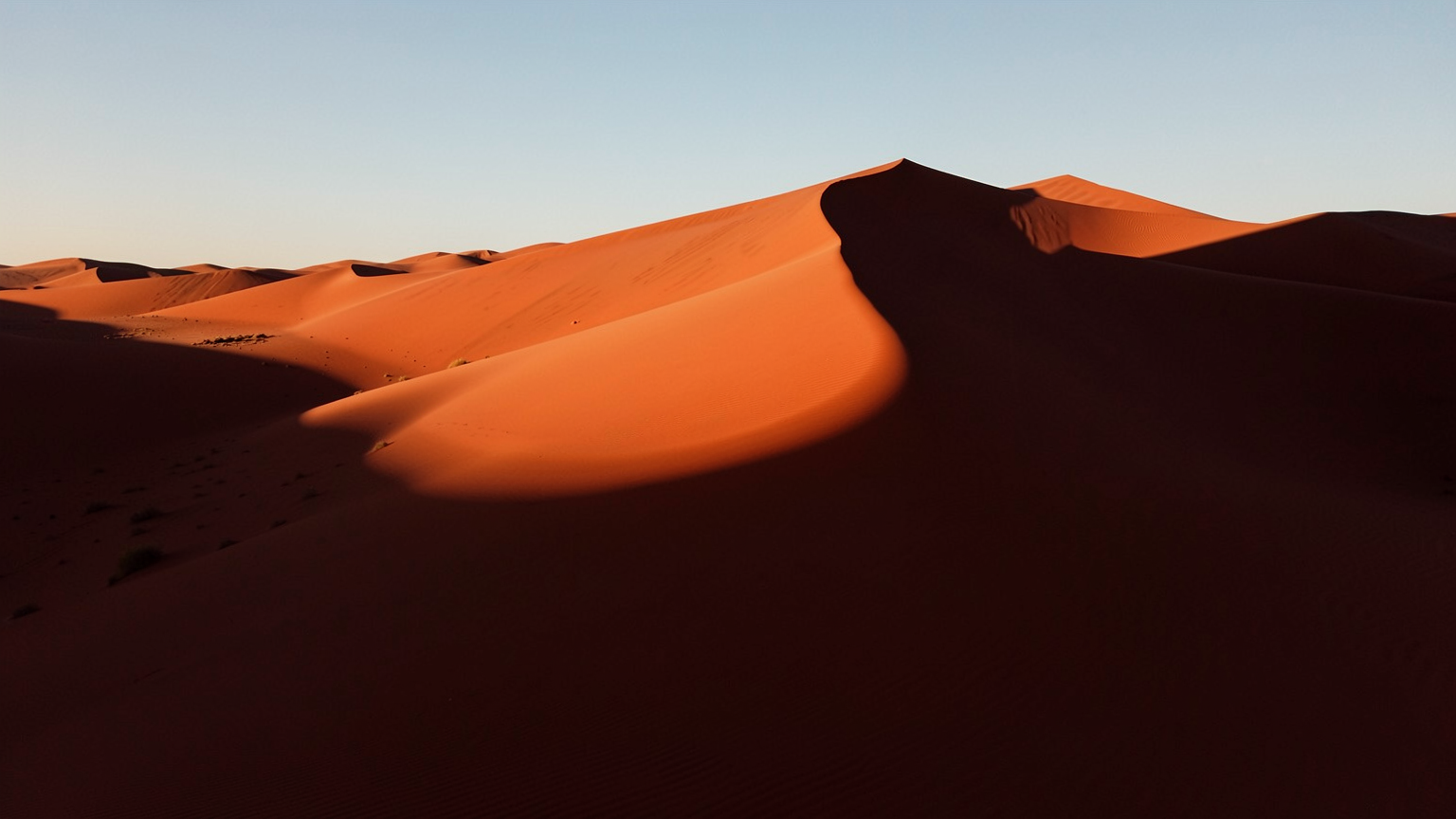
Dunes themselves come in recognisable forms. Barchans are crescents that migrate downwind. Linear dunes run in long parallel ridges, as in Australia's Simpson Desert. Star dunes, built by winds from several directions, rise into the tallest and most sculptural forms on earth, and they are the ones that hold shadow most dramatically at dawn.
The Arabian sand seas
The Rub' al Khali, or Empty Quarter, is the largest continuous sand desert in the world, spreading across Saudi Arabia, Oman, the United Arab Emirates and Yemen. Wilfred Thesiger crossed it twice in the late 1940s and wrote about it in Arabian Sands, still the most honest account of its demands. Today, travellers usually approach from the Liwa Oasis in Abu Dhabi or from southern Oman, always with experienced crews.
In Oman, the Sharqiya Sands (once called the Wahiba Sands) offer a more compact sand sea within reach of Muscat. In southern Jordan, Wadi Rum is a different kind of desert altogether: sandstone and granite mountains rising from red sand valleys, protected and inscribed on the UNESCO World Heritage List in 2011. Wadi Rum's routes are largely guided by members of the local Bedouin community, and walking there in spring or autumn is one of the quietest ways to feel desert scale.
North Africa
Morocco's Erg Chebbi, near Merzouga, is a contained sand sea with ridges that sharpen beautifully in morning light. Further south, Erg Chigaga, reached by track from M'Hamid, feels emptier and asks more of vehicles and drivers. In Egypt, the chalk formations of the White Desert and the dune ranges of the Great Sand Sea stretch toward the oasis of Siwa. In Algeria, Tassili n'Ajjer holds one of the world's great collections of prehistoric rock art, best visited with licensed local guides and the patience that permits require.
Southern Africa
The Namib is often described as one of the oldest deserts on earth. At Sossusvlei, inside the Namib-Naukluft National Park, rust-red dunes enclose pale clay pans. Nearby Deadvlei holds blackened camelthorn trees that have stood lifeless for centuries, preserved by the dryness. Along the Skeleton Coast, Atlantic fog rolls inland and gives the desert a cool, muted palette. Inland, the Kalahari is technically semi-arid, a savannah of red sand and grass that supports far more wildlife than its name suggests.
The Americas and Asia
Chile's Atacama is among the driest non-polar places on earth. Around San Pedro de Atacama, salt flats and the eroded ridges of the Valle de la Luna sit at altitude, so acclimatisation matters as much as hydration. In Mongolia, the Gobi holds Khongoryn Els, dunes known for the low hum they produce when sand slides. In California, Death Valley reaches summer temperatures that are routinely dangerous; it is a winter destination for anyone without strong reasons to go in July.
| Desert | Calmer months | Main consideration |
|---|---|---|
| Rub' al Khali | November to March | Extreme summer heat, vast distances |
| Wadi Rum | March to May, September to November | Cold winter nights |
| Erg Chebbi | October to April | Spring sandstorms |
| Namib | May to September | Park gate times limit dawn access |
| Atacama | Most of the year | Altitude and strong ultraviolet light |
| Gobi | June to September | Severe winter cold |
Photographing the dunes
Dunes are drawn by low light. In the first and last hour, side light separates crest from slope and the shadows turn violet and deep. By mid-morning the same landscape flattens into one bright tone. Plan your position the evening before, and walk there in darkness along a route that keeps your own footprints out of the frame.
Expose for the brightest sand. Highlights on a sunlit crest clip quickly, while a dark shadow can remain dark without harming the image; that contrast is the subject. A longer lens compresses distant ridges into layered bands, and a wide lens works best when something real anchors the foreground, such as wind ripples or a single camelthorn branch.
Sand is relentless with equipment. Change lenses inside a vehicle or a large bag, carry a blower rather than a cloth, and keep spare batteries close to your body during cold desert nights. Ask before photographing people, observe park rules about drones, and never ask a driver to perform an unsafe manoeuvre for a picture.
Continue with choosing a guide or remote stays.