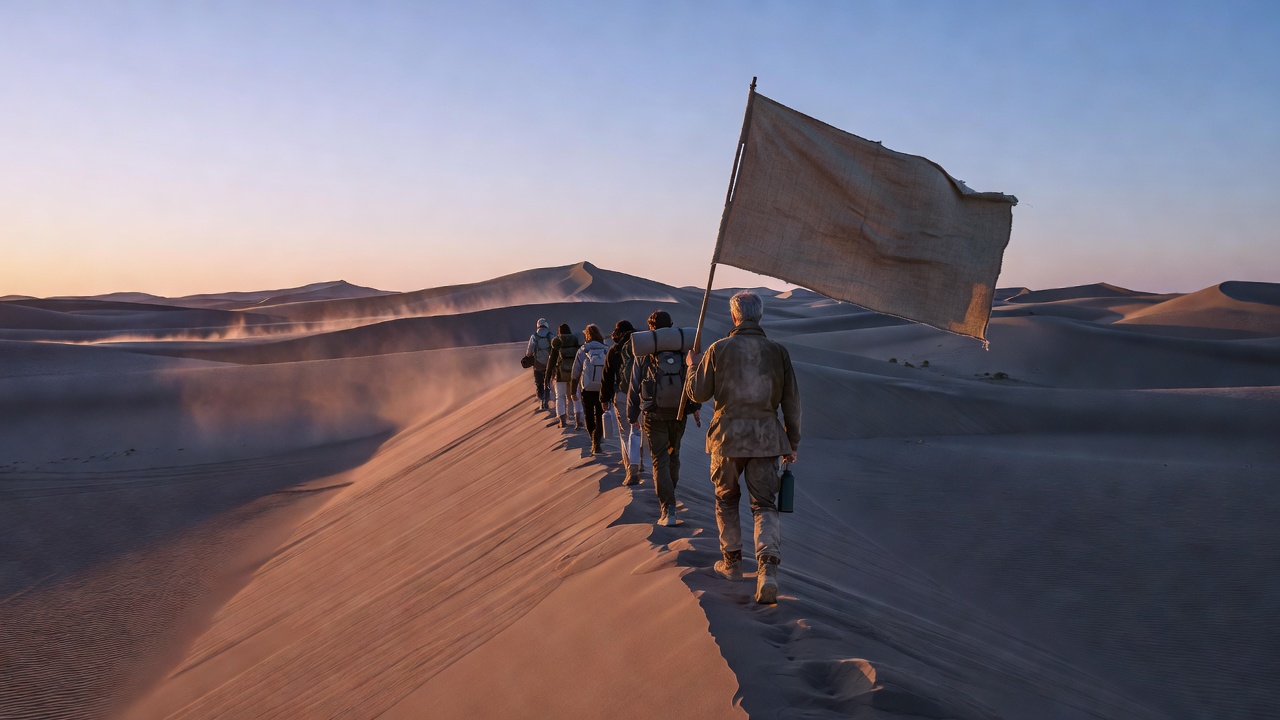
What a guide actually carries
A good desert guide carries maps, water and a radio, but the essential load is invisible. They know how a track changes after wind, where soft sand pools behind a dune, which wadi floods after distant rain and when the afternoon heat makes walking unwise. They read the group as closely as the ground, noticing who is drinking too little or quietly struggling. Wilfred Thesiger travelled the Empty Quarter with Bedu companions whose knowledge he never stopped describing as the reason he survived. That truth has not changed with satellite navigation.
The best guides are also editors. They decide what to leave out of the day: the extra detour, the steeper dune, the late start. Their restraint is often what makes a journey feel spacious rather than rushed.
Credentials worth asking about
Ask whether lead guides hold current wilderness first aid training. A Wilderness First Aid course typically runs over about sixteen hours; a Wilderness First Responder qualification is far more substantial and suits longer, deeper expeditions. Ask when it was last renewed. Ask too about licensing. Many countries, including Jordan and Morocco, license guides through national tourism authorities, and protected areas such as Wadi Rum or the Namib-Naukluft National Park have their own entry and permit systems. A legitimate operator will explain these without hesitation.
Vehicles, ratios and communication
For any route into deep sand or beyond reliable rescue, two vehicles should be the minimum, so that one can recover or carry the other's passengers. Ask how many guests share each vehicle, whether drivers have been trained in sand recovery, and what spare parts travel with the convoy. Ask what communication is carried every day: a satellite phone or two-way satellite messenger, and ideally a personal locator beacon as a last resort. Mobile coverage disappears quickly, and an expedition that relies on it is not prepared.
Finally, ask for the evacuation plan. Where is the nearest clinic that can stabilise a casualty? How long would a road transfer take? Is air evacuation possible, and who pays? Honest answers often include the phrase "many hours". That is not a reason to avoid the trip; it is a reason to travel with insurance that explicitly covers remote evacuation.
Guide-selection checklist
Before you commit
- Lead guide holds current wilderness first aid training
- Guides are licensed or recognised by local authorities
- Two or more vehicles on deep-sand routes
- Satellite communication carried daily, plus a locator beacon
- Written evacuation plan with realistic timings
- Group size of roughly twelve or fewer per lead guide
- Leave No Trace practices explained before departure
- Clear guidance on photographing people and sites
Red flags
Walk away if you hear
"We never need a second vehicle." "Phones work everywhere." "Insurance is optional." "We can do the dunes at speed for photos."
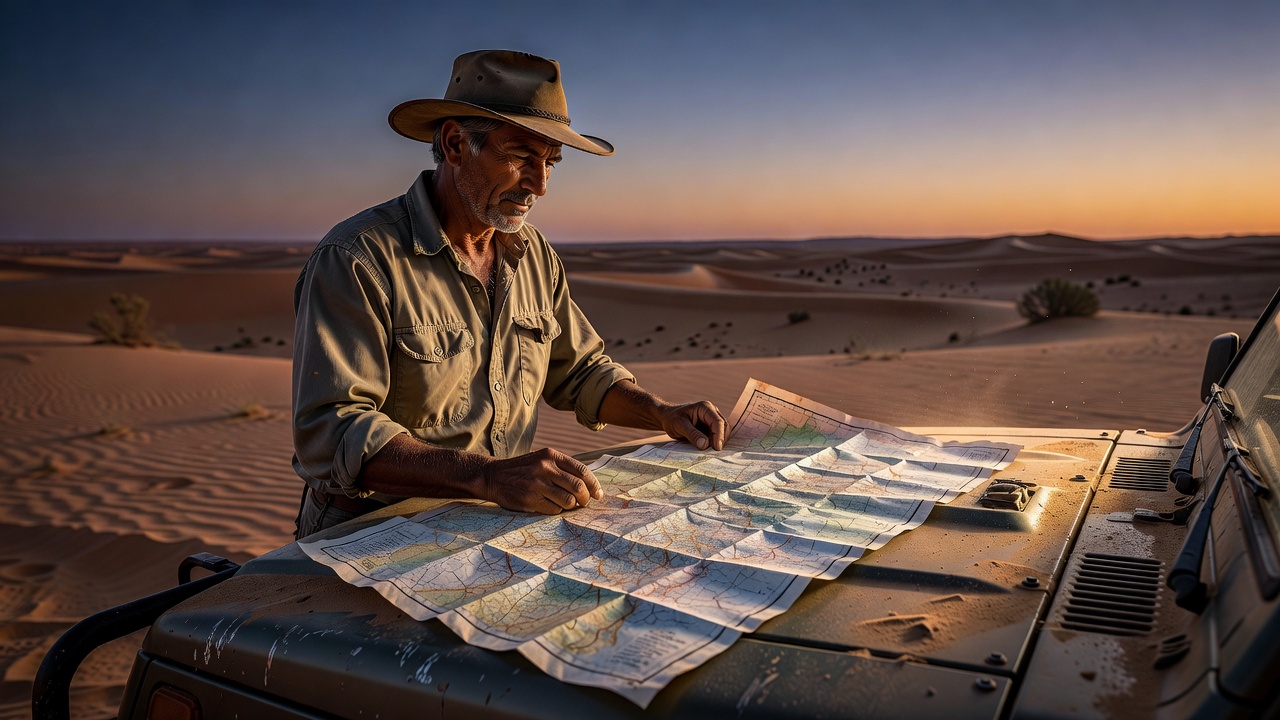
Navigation
Paper maps remain the backup that never runs out of battery.
Group size and pace
Small groups move more quietly, recover faster and leave less trace. A useful rule is that a lead guide should be able to see and speak with every guest without effort. Ask how the day is structured: early starts, long midday rests in shade and short walks in the cool evening are signs of a crew that understands heat. A schedule that packs activities into the afternoon is a warning, not a bonus.
Travelling with respect
Deserts are not empty. Wadi Rum is home to Bedouin families; much of the central Sahara is Tuareg country; Namibia's Kunene region is home to Himba communities. Good guides introduce these places with context and consent. They will tell you when photography is unwelcome, when to accept tea and how to dress. They will also follow the seven principles of Leave No Trace: plan ahead, travel on durable surfaces, dispose of waste properly, leave what you find, minimise fire impacts, respect wildlife and be considerate of others.
Realistic limits
No guide can remove all risk. Weather turns, vehicles fail and bodies react unexpectedly to heat. A trustworthy guide will tell you what could go wrong and what they will do about it. If an operator promises a flawless, risk-free adventure, their confidence is the risk. We do not recommend or book specific operators; use these questions to make your own judgement.
Next: prepare beyond the road.